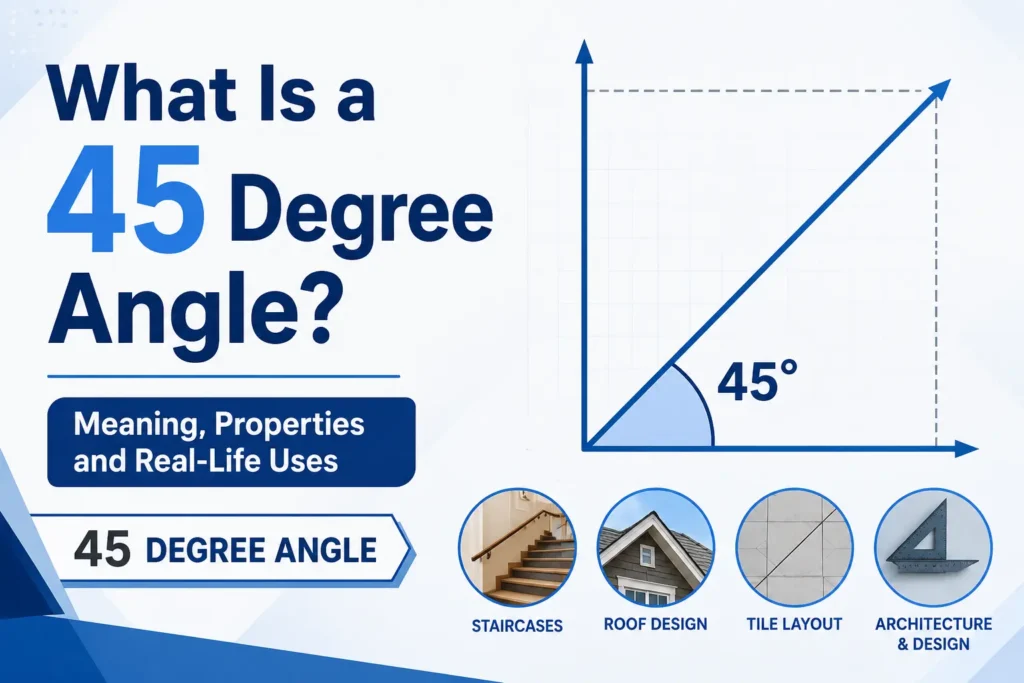
45 degree angle

What Is a 45 Degree Angle?

An angle is formed when two rays meet at a common point called the vertex, and angles are measured in degrees ranging from 0 to 360. Among the many angles used in mathematics, construction, and design, the 45 degree angle is one of the most common and useful. In this article, we will explain what a 45 degree angle is, how it is measured, how it is formed, and where it is used in everyday life.

Understanding a 45 Degree Angle

A 45 degree angle is exactly half of a 90 degree angle, which is also known as a right angle. If you imagine a right angle and draw a line that splits it perfectly into two equal parts, each of those parts will be a 45 degree angle. Because it falls between 0 and 90 degrees, a 45 degree angle is always classified as an acute angle. The number 45 comes from dividing 90 by 2, since a right angle contains exactly 90 degrees. This makes the 45 degree angle a very balanced and symmetrical angle, which is one reason it appears so often in geometry, design, and architecture.

Is a 45 Degree Angle Acute or Obtuse?

Angles smaller than 90 degrees are called acute angles, while angles larger than 90 degrees are called obtuse angles. Since a 45 degree angle measures less than 90 degrees, it always falls into the acute angle category. It is neither a right angle nor an obtuse angle, but it is closely related to both because it is exactly half of a right angle.

How to Measure a 45 Degree Angle

The easiest way to measure a 45 degree angle is by using a protractor. Here is a simple method:
  1. Place the midpoint of the protractor exactly on the vertex of the angle.
  2. Align the baseline of the protractor with one of the rays forming the angle.
  3. Look at the point where the second ray crosses the protractor scale.
  4. If the reading shows 45, then you are looking at a 45 degree angle.
This method works well for checking angles drawn on paper, in technical drawings, or in geometry homework.

How to Draw a 45 Degree Angle

There are two common ways to construct a 45 degree angle. Using a protractor:
  1. Draw a straight line and mark a point on it as the vertex.
  2. Place the protractor on this point with the baseline along the line.
  3. Mark the point at the 45 degree reading on the scale.
  4. Join the vertex to this mark to complete the angle.

Using a compass: Another way to form a 45 degree angle is by first constructing a 90 degree angle using a compass and straightedge, and then bisecting it. Bisecting simply means dividing the angle into two equal halves. Since half of 90 is 45, this method gives a precise 45 degree angle without needing a protractor at all.

45 Degree Angle in a Right Triangle

One of the most important places a 45 degree angle appears is in a special triangle known as the 45-45-90 triangle. This is a right triangle where two of the angles measure 45 degrees each, and the third angle measures 90 degrees. Because two angles are equal, this triangle is also an isosceles triangle, meaning two of its sides are equal in length. Also Read: Nosey Animatronic: Features and Fun Facts In a 45-45-90 triangle, the sides always follow a fixed ratio. If the two shorter sides are of length x, the longest side, called the hypotenuse, will always equal x multiplied by the square root of 2. This predictable ratio makes the 45 degree angle extremely useful in trigonometry and helps students solve geometry problems more quickly.

Real Life Examples of a 45 Degree Angle

A 45 degree angle is not just a classroom concept; it appears frequently in the real world. Carpenters use a 45 degree angle to create miter joints, which allow two pieces of wood to fit together neatly at a corner, such as in picture frames. Ramps and staircases sometimes use a 45 degree slope for a steep yet manageable incline. Photographers often shoot from a 45 degree angle to create a natural, pleasing perspective. Roof designs sometimes include a 45 degree pitch for better water drainage during rain. In sports like football, cricket, or javelin throw, players often release the ball at an angle close to 45 degrees, since this generally produces the maximum possible distance.

Difference Between a 45 Degree Angle and Other Common Angles

It helps to compare the 45 degree angle with other well known angles. A 30 degree angle and a 60 degree angle together also form a 90 degree angle, just like two 45 degree angles do. A 90 degree angle is a right angle, and a 180 degree angle forms a straight line. The 45 degree angle sits exactly in the middle of these references, which is why it is often used as a starting point when teaching angle measurement in schools.

Why the 45 Degree Angle Matters

The 45 degree angle is important because it represents a perfect balance between zero and a right angle. It is easy to measure, easy to construct, and easy to work with in calculations because of its simple relationship with 90 degrees. This is why it is introduced early in geometry lessons and continues to be used widely across construction, art, sports, and engineering.

Conclusion

A 45 degree angle is an acute angle that is exactly half of a right angle. It can be measured using a protractor and constructed either directly or by bisecting a 90 degree angle with a compass. It also plays a key role in the 45-45-90 triangle, where it helps define fixed and predictable side ratios. Beyond mathematics, the 45 degree angle is widely used in construction, carpentry, photography, and sports because of its simplicity and natural balance. Understanding this angle gives a strong foundation for learning more advanced concepts in geometry and trigonometry.