
What Are Squatters' Rights?
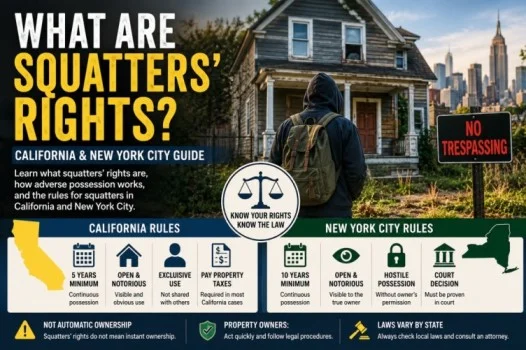
Squatters' rights refer to legal protections that may apply when someone occupies property without permission for an extended period and meets specific legal requirements. These rights are often associated with adverse possession. Simply staying in an empty or abandoned property for a short time does not make someone the legal owner.What Is Adverse Possession?
Adverse possession is a legal principle that can allow someone to claim ownership of property after occupying it for a legally required period while meeting specific conditions. Requirements vary by state, but commonly include:- Continuous possession
- Open and visible occupation
- Exclusive possession
- Occupation without the owner's permission
- Compliance with other state requirements
Why Do Squatters Have Rights?
People often ask why squatters have rights when they do not own the property. These laws are designed to resolve long-term property disputes, encourage owners to maintain their property, and provide a legal process for determining property rights. The purpose is not to reward trespassing or give people instant ownership of vacant homes.Squatters' Rights in California
California recognizes adverse possession, but strict requirements must be satisfied before someone can claim ownership. These requirements can include long-term continuous possession and, in many circumstances, payment of property taxes. If a California property owner discovers unauthorized occupants, they should respond promptly and follow the appropriate legal process. Attempting to remove occupants through self-help measures can create additional legal problems.Squatters' Rights in NYC
When discussing squatters' rights in NYC, it is important to distinguish New York City procedures from New York State property law. New York has rules involving adverse possession and landlord-tenant procedures. Depending on the circumstances, an unauthorized occupant may need to be removed through a formal court process. However, being an occupant does not automatically mean the person owns the property or qualifies for adverse possession. Property owners should follow applicable New York procedures when dealing with unauthorized occupants.Squatters vs. Trespassers
Squatters and trespassers are often confused, but they are not necessarily treated the same way. Squatter: May occupy property for an extended period and could potentially receive certain legal protections under specific circumstances. Trespasser: Generally enters or remains on property without authorization and does not automatically gain ownership rights. The legal classification depends on the facts and the applicable state or local law.Can Squatters Automatically Own Property?
No. A person does not become the owner of a property simply by living in an empty house. Adverse possession generally requires:- Meeting strict legal conditions
- Occupying the property for the required period
- Satisfying state-specific requirements
- Successfully establishing the claim through the appropriate legal process
How Can Property Owners Protect Their Property?
Owners can reduce the risk of unauthorized occupancy by:- Checking vacant properties regularly
- Securing doors and windows
- Maintaining the property
- Posting appropriate notices
- Responding quickly to unauthorized occupants
- Following legal eviction procedures