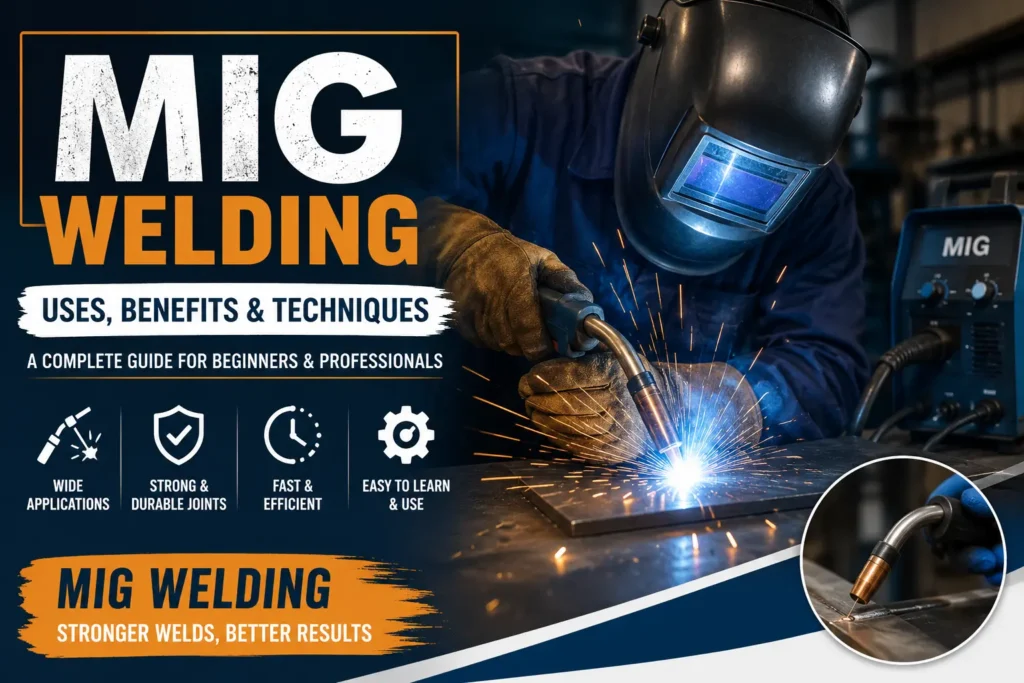
MIG welding is one of the most widely used welding methods because it is relatively fast, versatile, and easy to learn compared with many traditional welding processes. It is commonly used in workshops, manufacturing, automotive repair, construction, and metal fabrication.The term MIG stands for Metal Inert Gas welding. In this process, a continuously fed wire electrode creates an electric arc with the metal being welded. The heat from the arc melts the wire and base metal, forming a strong joint as the materials cool and solidify.
What Is MIG Welding?
MIG welding is an arc welding process that uses a continuously supplied consumable wire electrode. The wire is fed through a welding gun while an electrical current creates an arc between the wire and the workpiece.A shielding gas is normally used to protect the molten weld pool from contamination by surrounding air. Common shielding gases include argon, carbon dioxide, or mixtures of these gases, depending on the material and welding application.Because the welding wire is continuously fed, the operator does not need to stop frequently to replace an electrode. This makes MIG welding suitable for projects that require longer and more consistent welds.
How Does MIG Welding Work?
The basic process of MIG welding involves several important steps.First, the workpiece is cleaned and positioned correctly. The welding machine is then configured according to the material, wire size, and required welding conditions.When the trigger on the welding gun is pressed, the machine feeds the welding wire toward the workpiece. At the same time, electrical current creates an arc between the wire and the metal.The arc produces enough heat to melt the wire and part of the base metal. The molten material forms a weld pool, which joins the pieces together as it cools.Shielding gas flows from the welding gun around the arc and weld pool. Its purpose is to reduce exposure to atmospheric gases that can affect weld quality.
Main Features of MIG Welding
MIG welding has several characteristics that make it useful for different applications.
Continuous Wire Feeding
One of the main features is continuous wire feeding. The operator can produce relatively long welds without repeatedly stopping to replace a welding rod.
Fast Welding
MIG welding can provide a relatively high welding speed. This makes it useful for production environments and projects involving multiple welds.
Easy to Learn
Compared with some other welding processes, MIG welding has a straightforward operating method. Beginners can learn basic techniques with proper training and practice.
Adjustable Settings
Modern MIG welding machines usually allow operators to adjust settings such as wire feed speed and voltage. Correct settings help produce a stable arc and suitable weld penetration.
Uses of MIG Welding
MIG welding is used across many industries and applications.
Automotive Work
MIG welding is commonly used for vehicle repair and fabrication. It can be useful for joining different types of automotive metal components when the correct equipment and settings are used.
Metal Fabrication
Fabrication shops use MIG welding to manufacture frames, brackets, panels, supports, and other metal structures.
Construction
MIG welding can be used for certain construction and structural fabrication tasks. The specific welding process depends on the material, design, standards, and required strength.
Manufacturing
Manufacturers may use MIG welding for producing metal products and components. Its continuous wire feed can make it suitable for repetitive welding operations.Also Read:ICT: Uses, Benefits & Importance
Home and Workshop Projects
MIG welding machines are also used in smaller workshops for repair and fabrication projects. However, proper safety equipment and welding knowledge are essential.
Benefits of MIG Welding
There are several reasons why MIG welding is popular.
High Productivity
Continuous wire feeding can reduce interruptions and help operators complete welding work efficiently.
Versatility
MIG welding can be used with various metals when the appropriate wire, shielding gas, machine settings, and technique are selected.
Good Weld Appearance
When the machine is properly adjusted and the operator uses the correct technique, MIG welding can produce clean and consistent welds.
Less Electrode Replacement
Unlike welding processes that use individual stick electrodes, MIG welding uses a continuous wire spool. This can reduce the need for frequent electrode changes.
Suitable for Beginners
MIG welding is often considered a practical process for people learning basic welding skills because the equipment and operation can be relatively straightforward.
Limitations of MIG Welding
Despite its advantages, MIG welding also has limitations.Shielding gas can make the process less suitable for windy outdoor environments because air movement may disturb the shielding gas around the weld.The equipment can also be more complicated than basic stick welding equipment because it requires a welding machine, wire feeder, welding gun, and gas system when gas-shielded operation is used.Another limitation is that surface preparation is important. Dirt, rust, paint, oil, and other contaminants can negatively affect weld quality.MIG welding also requires appropriate settings for different materials and thicknesses. Incorrect voltage, wire feed speed, travel speed, or shielding gas can result in welding problems.
Common MIG Welding Techniques
Using the correct technique is important for producing a quality weld.
Maintain the Correct Distance
The distance between the welding gun and workpiece affects the arc and weld quality. Operators should follow the equipment manufacturer's recommendations for the appropriate contact-tip-to-work distance.
Keep a Consistent Travel Speed
Moving the welding gun too quickly can produce a narrow or insufficient weld, while moving too slowly can cause excessive heat and an overly large weld.
Use the Correct Angle
The welding gun should generally be held at a suitable angle for the joint and welding position. A consistent angle helps maintain control over the weld pool.
Prepare the Metal
Cleaning the workpiece before welding can help reduce contamination and improve weld quality. Remove dirt, grease, rust, paint, and other unwanted materials where appropriate.
MIG Welding Safety
Safety should always be a priority when performing MIG welding.Welders should use an appropriate welding helmet with the correct shade, welding gloves, protective clothing, and suitable footwear. The work area should have adequate ventilation to reduce exposure to welding fumes.Keep flammable materials away from the welding area because welding produces intense heat, sparks, and hot metal.The welding machine, cables, connections, and gas equipment should also be inspected before use. Always follow the manufacturer's safety instructions and applicable workplace requirements.
MIG Welding vs. Other Welding Methods
MIG welding differs from processes such as stick welding and TIG welding.Stick welding uses a consumable electrode that is coated with flux, while MIG welding generally uses a continuously fed wire electrode.TIG welding uses a non-consumable tungsten electrode and provides greater control for many precision applications, but it can require more skill and may be slower for certain jobs.The best welding process depends on the material, thickness, joint design, working environment, required appearance, and project requirements.
Frequently Asked Questions
Is MIG welding easy to learn?
MIG welding is often considered one of the more accessible welding processes for beginners. However, proper instruction, practice, and safety knowledge are still important.
What metals can be welded with MIG welding?
MIG welding can be used with several metals, including common forms of steel, stainless steel, and aluminum, provided the appropriate wire, shielding gas, equipment, and settings are used.
Does MIG welding require gas?
Gas-shielded MIG welding requires shielding gas. Some related wire-feed welding setups can use flux-cored wire without an external shielding gas, depending on the equipment and wire type.
Is MIG welding suitable for thick metal?
MIG welding can be used on a range of material thicknesses, but the machine's capabilities, wire type, settings, joint preparation, and number of passes must be appropriate for the job.
Is MIG welding safe?
MIG welding can be performed safely when proper protective equipment, ventilation, fire prevention, equipment inspection, and safe welding practices are used.
Conclusion
MIG welding is a versatile and productive welding process used in automotive work, fabrication, manufacturing, construction-related applications, and workshops. Its continuous wire feed, adjustable settings, and relatively straightforward operation make it useful for both experienced welders and people learning welding.Good results depend on selecting the correct wire and shielding gas, preparing the metal properly, using suitable machine settings, maintaining consistent technique, and following appropriate safety practices. With proper training and practice, MIG welding can be an effective method for creating strong and reliable metal joints.
Author
Steven Mark
Creators
Exploring ideas, trends, and real-world stories to inspire fresh thinking, support daily learning, and help you discover something valuable every day.