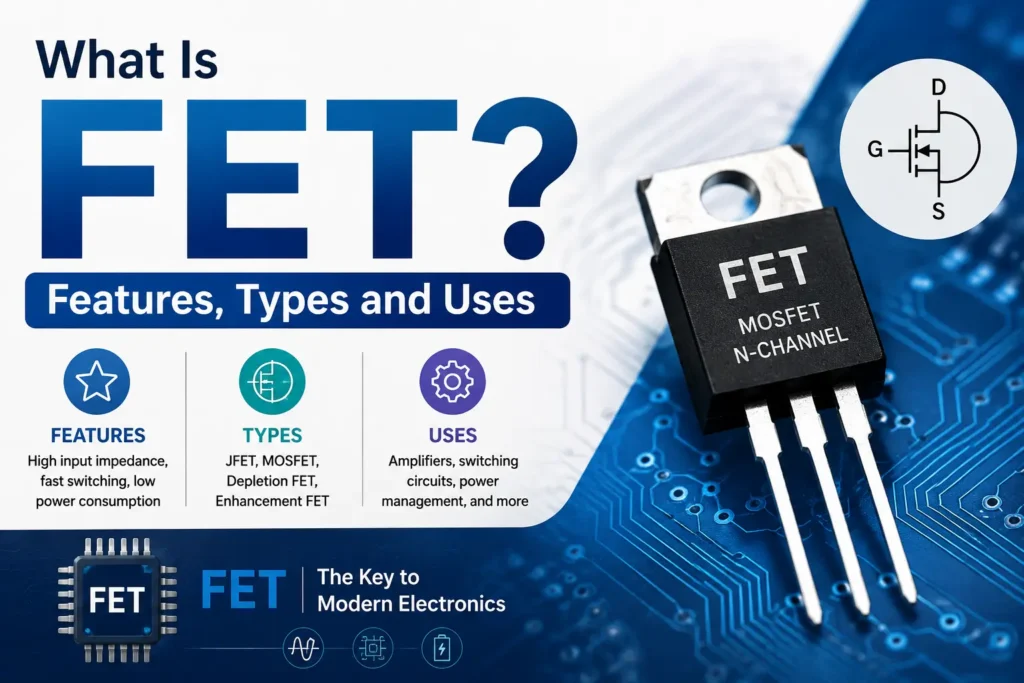

What Is FET?
A FET, or Field Effect Transistor, is a type of transistor that uses an electric field to control the width of a conducting channel and, as a result, the current flowing through it. It is called a unipolar device because only one type of charge carrier, either electrons or holes, is responsible for conduction. A FET has three main terminals: the gate, the source, and the drain. The gate terminal controls the current that flows between the source and the drain by applying a voltage rather than a current. This is one of the biggest differences between a FET and a Bipolar Junction Transistor (BJT), which is a current-controlled device. Because of this voltage-controlled nature, a FET consumes very little power and offers high input impedance.How Does FET Work?
The basic working principle of a FET revolves around the electric field created at the gate terminal. When a voltage is applied to the gate, it creates an electric field that either widens or narrows the conducting channel between the source and the drain. This change in channel width directly affects the amount of current that can pass through the device. Since the gate is separated from the channel by an insulating layer or a reverse-biased junction, almost no current flows into the gate itself. This is why a FET is known for its extremely high input impedance and low power consumption compared to other transistor types.Features of FET
A FET comes with several distinctive features that make it suitable for a wide range of electronic applications. Some of the most important features include:- High input impedance, which allows a FET to draw very little current from the input signal source.
- Low noise generation, making a FET ideal for sensitive applications like RF amplifiers.
- Voltage-controlled operation instead of current-controlled operation.
- Better thermal stability compared to bipolar transistors.
- Unipolar conduction, since only one type of charge carrier is involved.
- Compact size, which makes a FET highly suitable for integrated circuits.
- Low power consumption, especially in battery-operated devices.
Types of FET
There are two major categories of FET, each with its own sub-types based on construction and working principle.1. JFET (Junction Field Effect Transistor)
A JFET is the simplest form of FET. It works by using a reverse-biased pn junction to control the current flow through the channel. A JFET is further divided into two types:- N-channel JFET: In this type, the channel is made of n-type material, and electrons act as the majority charge carriers.
- P-channel JFET: In this type, the channel is made of p-type material, and holes act as the majority charge carriers.
2. MOSFET (Metal Oxide Semiconductor Field Effect Transistor)
A MOSFET is a more advanced and widely used type of FET. It uses a metal gate insulated from the channel by a thin oxide layer, which gives it even higher input impedance than a JFET. A MOSFET is divided into two main categories:- Depletion type MOSFET: The channel already exists, and applying a gate voltage can either increase or decrease its width.
- Enhancement type MOSFET: The channel does not exist initially, and it is created only when a sufficient gate voltage is applied.
Uses of FET
The unique properties of a FET make it useful in a wide range of practical applications. Some of the common uses include:- Amplifier circuits: A FET is widely used in audio and RF amplifiers because of its low noise characteristics.
- Switching applications: Due to its fast switching speed, a FET is commonly used as an electronic switch in digital circuits.
- Voltage-controlled resistors: A FET can act as a variable resistor whose resistance changes with gate voltage.
- Integrated circuits: MOSFET-based FETs are the building blocks of modern microprocessors and memory chips.
- Oscillators: A FET is used in oscillator circuits to generate stable frequency signals.
- Power electronics: Power MOSFETs, a type of FET, are used in power supplies, inverters, and motor control circuits.
- Sensors and instrumentation: The high input impedance of a FET makes it suitable for interfacing with sensitive sensors.