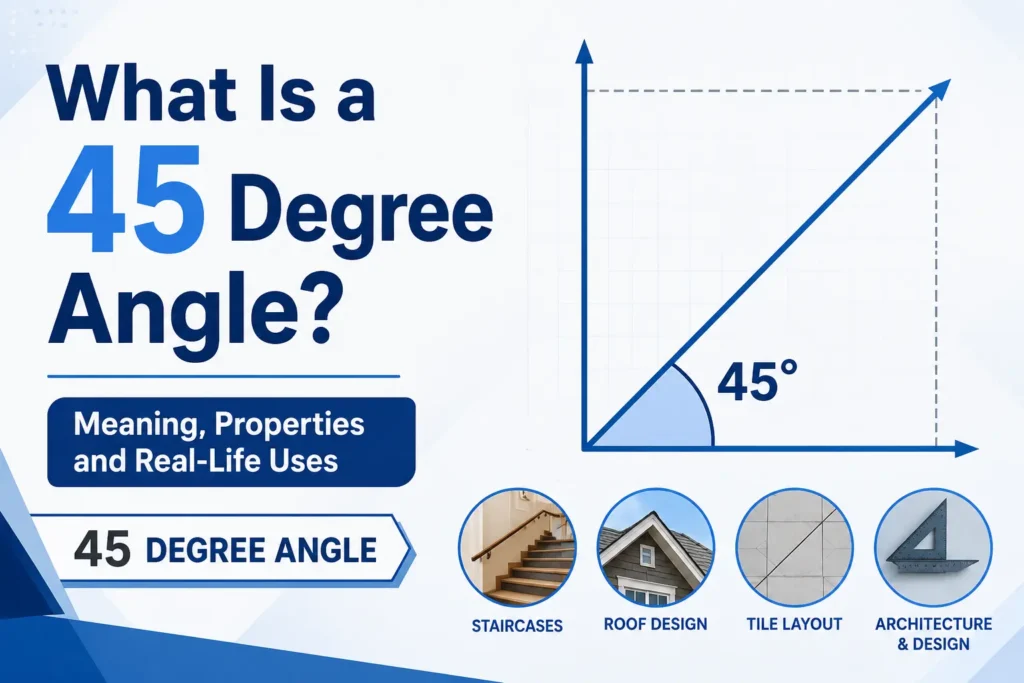

Understanding a 45 Degree Angle
A 45 degree angle is exactly half of a 90 degree angle, which is also known as a right angle. If you imagine a right angle and draw a line that splits it perfectly into two equal parts, each of those parts will be a 45 degree angle. Because it falls between 0 and 90 degrees, a 45 degree angle is always classified as an acute angle. The number 45 comes from dividing 90 by 2, since a right angle contains exactly 90 degrees. This makes the 45 degree angle a very balanced and symmetrical angle, which is one reason it appears so often in geometry, design, and architecture.Is a 45 Degree Angle Acute or Obtuse?
Angles smaller than 90 degrees are called acute angles, while angles larger than 90 degrees are called obtuse angles. Since a 45 degree angle measures less than 90 degrees, it always falls into the acute angle category. It is neither a right angle nor an obtuse angle, but it is closely related to both because it is exactly half of a right angle.How to Measure a 45 Degree Angle
The easiest way to measure a 45 degree angle is by using a protractor. Here is a simple method:- Place the midpoint of the protractor exactly on the vertex of the angle.
- Align the baseline of the protractor with one of the rays forming the angle.
- Look at the point where the second ray crosses the protractor scale.
- If the reading shows 45, then you are looking at a 45 degree angle.
How to Draw a 45 Degree Angle
There are two common ways to construct a 45 degree angle. Using a protractor:- Draw a straight line and mark a point on it as the vertex.
- Place the protractor on this point with the baseline along the line.
- Mark the point at the 45 degree reading on the scale.
- Join the vertex to this mark to complete the angle.