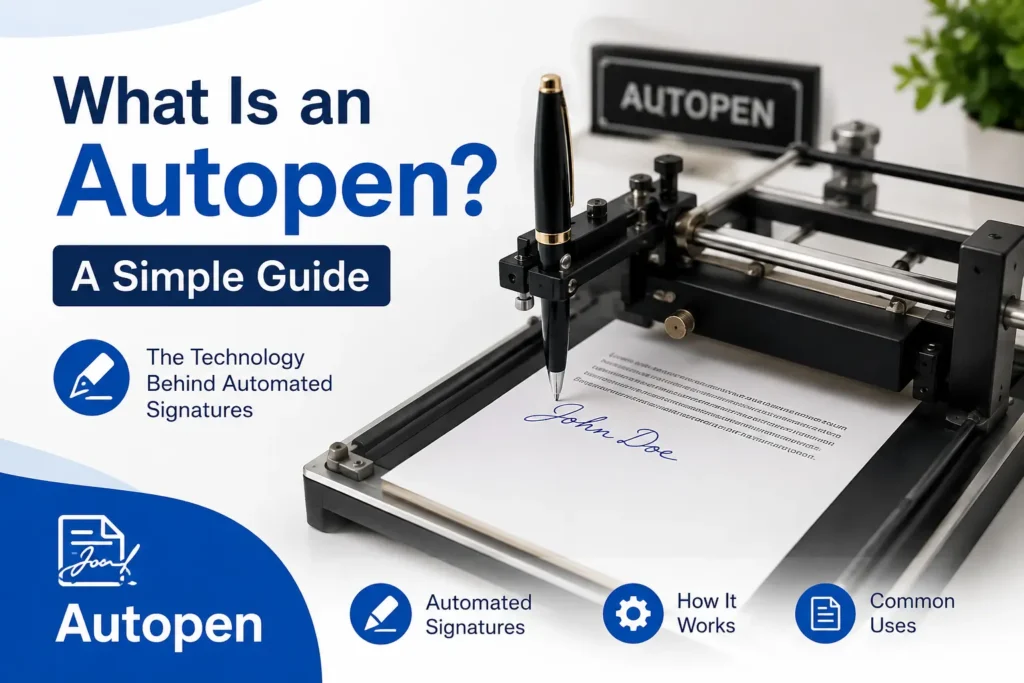
If you have ever wondered how busy executives, celebrities, or even presidents manage to sign thousands of documents, letters, and photographs without personally holding a pen for each one, the answer often lies in a fascinating piece of technology called an autopen. This simple guide will walk you through everything you need to know about the autopen, how it works, its history, and why it remains relevant even in today's digital age.
Understanding the Basics of an Autopen
An autopen is a mechanical or robotic device designed to reproduce a person's signature automatically. Instead of a human hand physically writing the signature every single time, the autopen uses a pre-recorded pattern of the person's handwriting and replicates it on paper with a real pen. The result looks like an authentic, handwritten signature, complete with natural variations in pressure and stroke, making it difficult to distinguish from the real thing at a glance.The core idea behind the autopen is simple: save time. Public figures, business leaders, and government officials often need to sign an overwhelming number of documents, from official letters to contracts, certificates, and fan mail. Signing each one by hand would take hours or even days. An autopen allows these signatures to be produced quickly, accurately, and consistently.
How Does an Autopen Work?
At its core, an autopen operates using a mechanical arm that holds a real pen. This arm is guided by a template or a digital record of the person's original signature. The machine moves the pen across the paper following the exact path of the signature, replicating the curves, loops, and pressure points as closely as possible.Older autopen models used a physical matrix or pattern plate that guided the pen mechanically, almost like a stencil system connected to gears and motors. Modern autopens, however, often rely on digital signature data stored in software. This data controls robotic arms with a level of precision that can capture even the smallest nuances of a person's handwriting style.Because the device uses an actual pen and applies real pressure to the paper, the signature it produces is a genuine ink signature, not a printed or scanned image. This is one of the key reasons autopen signatures can sometimes be legally recognized as authentic, provided proper authorization and disclosure practices are followed.
A Brief History of the Autopen
The concept of mechanically reproducing handwriting is not new. Devices resembling early autopens date back to the early 1800s, when inventors experimented with mechanical writing machines to help people with disabilities or to assist scribes in duplicating letters. However, the modern autopen as we recognize it today became widely known in the twentieth century.One of the most famous historical uses of the autopen involves United States presidents. Several presidents have used autopens to sign letters, greeting cards, and even certain official documents when their physical presence was not possible. This practice sparked public curiosity and, at times, controversy, particularly around questions of whether a president can legally sign bills into law using an autopen while traveling or unavailable to sign in person.Beyond politics, autopens have long been used by authors for signing book copies, by musicians for autographing merchandise, and by corporate executives who must sign large volumes of correspondence and legal paperwork.
Common Uses of an Autopen Today
Autopens remain relevant in several fields and industries. Some of the most common uses include:Government and political offices, where officials sign proclamations, letters to constituents, or ceremonial documents.Corporate environments, where CEOs and executives need to sign contracts, checks, or employee correspondence at scale.Celebrities and public figures, who use autopens to sign autographs for fans without needing to personally handle every single item.Publishing and entertainment industries, where authors sign special editions of books that will be sold to a wide audience.Nonprofit organizations, which often send out donor appreciation letters signed by directors or founders.Also Read: EV News: Trends, Updates and New ModelsIn each of these cases, the autopen allows the signer to maintain a personal touch in their communications without sacrificing the time needed to run their organization or career.
Is an Autopen Signature Legally Valid?
This is one of the most frequently asked questions about autopens, and the answer depends largely on context and jurisdiction. In many legal systems, a signature does not necessarily need to be applied personally by the signer's own hand to be valid. What often matters more is the signer's intent and authorization. If a person has approved the use of their signature through an autopen for a specific document, that signature can be considered legally binding.However, this is a nuanced area of law, and rules can vary significantly depending on the type of document, the country, and the specific legal requirements involved. Highly sensitive documents, such as wills or certain contracts, may require an original, handwritten signature to be considered valid, and an autopen version might not be accepted for these purposes. It's always wise to check relevant regulations before relying on an autopen for anything with major legal consequences.
Advantages and Disadvantages of Using an Autopen
Like any tool, autopens come with both benefits and drawbacks.On the positive side, they save a significant amount of time for people who must sign large numbers of documents. They also maintain the appearance of a personal, handwritten signature rather than a cold, printed one. Additionally, they allow signatures to remain consistent across various documents.On the downside, there is potential for misuse if someone uses an autopen without proper authorization. This raises ethical and legal concerns, particularly in professional or political settings. There is also the psychological aspect, some people may feel that an autopen signature lacks the same personal warmth or authenticity as one signed by hand, especially for sentimental items like autographed memorabilia.
Final Thoughts
An autopen is a clever blend of mechanical engineering and personal identity, allowing important figures to keep up with the demands of their busy schedules while still preserving the feel of a handwritten signature. Whether used by a president, a bestselling author, or a corporate executive, this device demonstrates how technology can support tradition rather than replace it entirely.Understanding what an autopen is, and how it works, helps demystify a tool that plays a quiet but significant role behind the scenes in many high-profile signatures we see today.
Author
Steven Mark
Creators
Exploring ideas, trends, and real-world stories to inspire fresh thinking, support daily learning, and help you discover something valuable every day.