If you drive an automatic transmission vehicle, there is a good chance you have never thought twice about how power actually travels from your engine to your wheels without a clutch pedal. The answer lies in a small but ingenious piece of hydraulic engineering called the torque converter. Unlike a manual transmission, which uses a mechanical clutch to connect and disconnect the engine from the gearbox, an automatic transmission relies on fluid coupling to transfer rotational force. This article breaks down what a torque converter is, how it works, and why it remains such an essential part of automatic vehicles today.
What Is a Torque Converter?
A torque converter is a type of fluid coupling that transfers power from the engine to the transmission. It sits between the engine's flexplate and the transmission input shaft, and its job is to allow the engine to keep running even when the vehicle is stationary, such as when you are stopped at a red light. Instead of using a solid mechanical link like a clutch, this device uses transmission fluid to transmit torque smoothly and efficiently. This design not only enables seamless gear shifts but also multiplies torque under certain conditions, giving the vehicle extra power when it needs it most, such as during acceleration from a standstill.
The Main Components
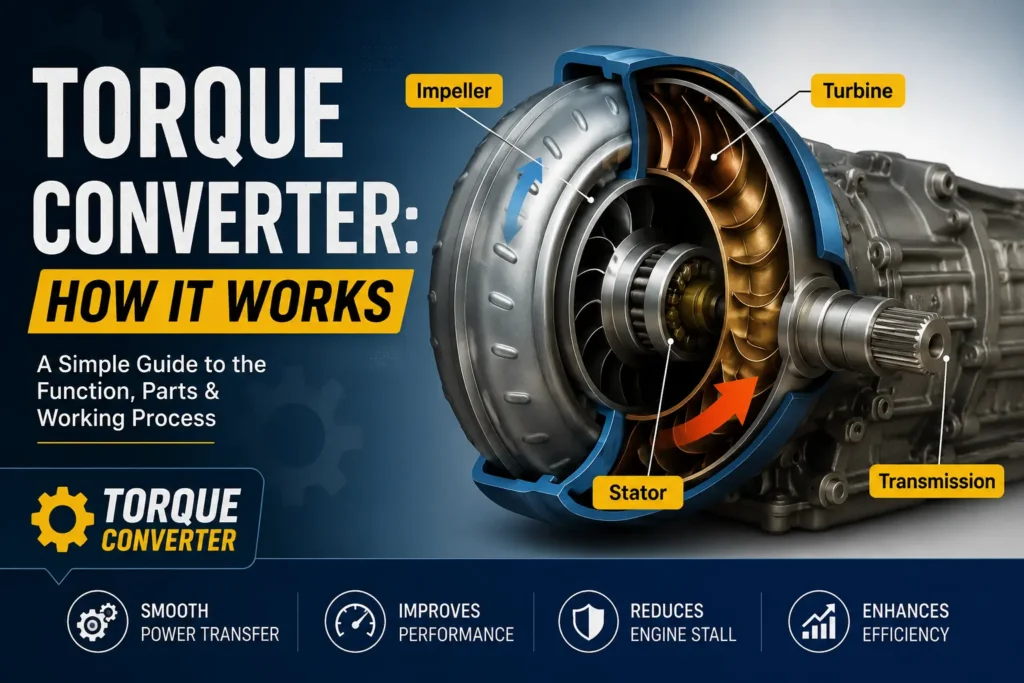
To understand how a torque converter works, it helps to know its four primary internal parts, each housed inside a sealed, doughnut-shaped casing filled with transmission fluid.The impeller, also called the pump, is connected directly to the engine's flexplate and spins at the same speed as the engine. As it rotates, its curved blades fling transmission fluid outward using centrifugal force, much like a fan pushes air.The turbine sits opposite the impeller and is connected to the transmission's input shaft. It receives the fluid flung out by the impeller and converts that fluid energy back into rotational motion, which then drives the transmission and, ultimately, the wheels.The stator is positioned between the impeller and the turbine. Its role is often misunderstood, but it is arguably the cleverest part of the entire assembly. The stator redirects the fluid returning from the turbine before it reaches the impeller again, ensuring the fluid flows in a direction that assists rather than hinders the impeller's rotation. This redirection is what allows torque multiplication to occur.Finally, the lock-up clutch is a more modern addition found in most contemporary torque converters. Once the vehicle reaches a certain speed, this clutch mechanically locks the impeller and turbine together, eliminating fluid slippage and improving fuel efficiency.
How the Fluid Transfers Power
The entire process begins the moment the engine starts running. The impeller spins along with the engine and begins pushing transmission fluid outward and toward the turbine. This fluid strikes the turbine's blades, causing it to spin as well, and that rotational energy is passed along to the transmission and drivetrain.At low engine speeds, such as when idling at a stoplight, the impeller spins slowly, and the resulting fluid flow is too weak to spin the turbine with much force. This is why a vehicle can sit in gear without stalling or lurching forward, even though the engine is turning. As the driver presses the accelerator, the impeller spins faster, pushing fluid with greater force, which in turn spins the turbine faster and moves the vehicle forward.Also Read:What Is Domikyo.com? A Simple GuideThe stator plays its part during this process by catching the fluid as it exits the turbine and redirecting it back toward the impeller at an optimal angle. Without the stator, the returning fluid would hit the back of the impeller blades and work against the engine's rotation, wasting energy. With the stator in place, the fluid rejoins the impeller's flow smoothly, which is what allows the system to multiply torque during acceleration, sometimes by a factor of two or more.
Torque Multiplication Explained
One of the most valuable features of this hydraulic system is its ability to multiply torque without any additional mechanical gearing. When there is a large difference between the impeller's speed and the turbine's speed, such as during initial acceleration, the stator redirects fluid in a way that adds extra rotational force to the impeller's output. This effect is strongest when the vehicle is stationary or moving slowly and gradually diminishes as the turbine catches up to the impeller's speed. Once both components are spinning at nearly the same rate, the stator's blades allow fluid to pass through more freely, and the torque multiplication effect fades, transitioning the unit into a simple fluid coupling.
The Role of the Lock-Up Clutch
While the fluid coupling design is effective, it inherently allows for some degree of slippage between the impeller and turbine, since power is transferred through fluid rather than a direct mechanical connection. This slippage, while beneficial for smooth engagement, can lead to a small amount of energy loss and reduced fuel economy at highway speeds. To address this, engineers introduced the lock-up clutch, a mechanism that engages once the vehicle reaches cruising speed. When activated, this clutch physically bonds the impeller and turbine, creating a direct mechanical link that eliminates fluid slippage entirely. This allows the vehicle to enjoy the smooth low-speed characteristics of a hydraulic coupling while still achieving the fuel efficiency of a direct mechanical connection at higher speeds.
Why This System Matters
The genius of this hydraulic design lies in its simplicity and reliability. It allows automatic vehicles to launch smoothly from a stop without stalling, provides a built-in torque boost during acceleration, and does all of this without requiring the driver to manage a clutch pedal. Compared to older mechanical designs, this fluid-based approach also reduces wear on transmission components since there is no direct metal-to-metal engagement during power transfer, aside from when the lock-up clutch is engaged.Modern vehicles have refined this technology considerably, with multi-stage stators, electronically controlled lock-up clutches, and computer-optimized fluid dynamics that improve both performance and efficiency. Even as electric vehicles grow in popularity and traditional automatic transmissions become less common in some segments, this hydraulic marvel remains a defining feature of countless gasoline and diesel-powered automatic vehicles on the road today.
Conclusion
Understanding this hydraulic power-transfer system reveals just how much thoughtful engineering goes into something drivers rarely notice during daily use. From the impeller's initial push to the stator's clever redirection and the turbine's final output, every component plays a precise role in delivering smooth, efficient power to the wheels. Whether you are accelerating from a stoplight or cruising on the highway, this often-overlooked assembly is quietly working behind the scenes to keep your automatic vehicle running smoothly.
Author
Steven Mark
Creators
Exploring ideas, trends, and real-world stories to inspire fresh thinking, support daily learning, and help you discover something valuable every day.